








 FileGrant
 RemoteGrant
 Connector
 AIGrant
 EmailGrant
 SecretGrant

Secure file sharing, built for business
Protection stays in the file, not in the perimeter. Share documents with clients, partners and external collaborators while keeping encryption, traceability and revocation even after sending.
What secure file sharing is, and why sharing needs rethinking
Secure file sharing is document sharing where protection stays in the file, not just in the network or the platform: the document is encrypted at creation and protection follows it even after it leaves the company. Sharing speeds up work, but every file that leaves widens the attack surface. According to the Verizon DBIR 2026, breaches involving third parties grew 60% in a year and now account for 48% of the total.
CyberGrant moves protection inside the file: native encryption, granular access control, revocation even after sending. Data is not born vulnerable to be chased along sharing channels, it is born protected and stays that way wherever it goes.
How NIS2 changes the way secure file sharing solutions are evaluated

Share with clients and partners without losing control of the file
Sharing documents with external users exposes data to unauthorized access and channel interception. And often no attack is needed: the human element is present in 62% of breaches (Verizon DBIR 2026), sometimes it is just a file sent to the wrong recipient.
With the file-centric approach of FileGrant, every file can be shared via email, cloud or messaging in encrypted Lock&Go format: the recipient sees only the metadata, while the content stays readable at destination only for those with permission. The encrypted download relies on the CRYSTALS-Kyber algorithm, NIST standard FIPS 203 (ML-KEM) since August 2024, and answers the "harvest now, decrypt later" logic. Control does not end at sending: post-share revocation withdraws access to a file already delivered, even on an external system.
Centralized storage and role-based access
A centralized, protected and well-organized space reduces fragmentation and the risks of data loss. The recurring weak point is indiscriminate access: too many people who can open too many documents. Role-based access control (RBAC) assigns granular permissions, Admin, Contributor or Reader, so that only authorized users reach sensitive resources.
Automatic classification, handled by the private on-premise AI of AIGrant, applies tags and restrictions consistent with company policy without manual work, and tags take priority over the user's actions: if a document is marked as non-downloadable, no one can download it. Every activity stays logged in a real-time audit trail: who opened a file, when and from where.


Protect documents from AI scraping and unauthorized capture
During meetings, shares and online collaboration, company documents can end up in public AI tools or be captured with screenshots. 67% of users access generative AI services with non-corporate accounts on work devices (Verizon DBIR 2026): this is Shadow AI, a channel perimeter controls do not see.
Anti-AI scraping protection prevents confidential content from being ingested by generative AI platforms, while anti-screen capture blocks captures during Zoom, Meet and Teams sessions, even in collaborative and shared environments. The same transparent protection extends to PCs and endpoints with RemoteGrant.
Virtual Data Room: a protected space for confidential operations
In mergers, acquisitions and confidential projects, a Virtual Data Room offers a protected environment to share sensitive information with counterparties and advisors. The stakes are high and the exposure window is long. CyberGrant solutions let you manage access, track every activity and protect documents centrally.
Persistent encryption and revocation stay active for the whole operation, even toward those outside the company. This is also where sharing meets compliance: GDPR (Article 32), NIS2 (Legislative Decree 138/2024) and DORA (Regulation EU 2022/2554) require encryption, access control and traceability, measures a file-centric platform meets natively.


Whitepaper
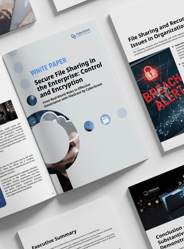
Gain full control of the files you share
Sharing fast is not enough: protecting every document means protecting your clients, your partners and business continuity.
FAQ
Secure file sharing is document sharing where protection stays in the file itself, not just in the network or the platform. The document is encrypted at creation and protection follows it even after sending, with access control, traceability and the option to revoke
Tools like SharePoint, OneDrive or company clouds manage file access within the perimeter. They do not natively encrypt the individual document, do not block AI scraping and do not allow access to be revoked after sharing. CyberGrant solutions sit alongside these tools and add the protection missing from data in motion.
Protection is tied to the file, not to the copy. Even after sending, you can revoke access, change permissions or set an expiry. The document becomes unreadable for anyone no longer authorized, without having to track down the distributed copies.
Encryption, access control and audit trail are measures required by GDPR (Article 32), NIS2 (Legislative Decree 138/2024) and DORA (Regulation EU 2022/2554). A file-centric platform makes them available natively, including when sharing with third parties and across the supply chain.
The external recipient can receive the file in encrypted format and access the content only with the correct permissions, for example through an OTP code. They see the metadata, but the content stays protected and tracked
Yes. If you already use SharePoint or OneDrive, FileGrant integrates with them and extends their protection: it adds persistent encryption, granular access control, post-share revocation and quantum-safe protection, following the file across any channel. You keep your existing stack and close the protection gap the perimeter alone leaves open.
Book your free demo
Talk to our security experts and learn how to protect sensitive data while enabling secure, seamless collaboration inside and outside your organization