









 FileGrant
 RemoteGrant
 Connector
 AIGrant
 EmailGrant
 SecretGrant

File-centric business email security
Every message and every attachment stays under your control after you hit send, because the protection lives in the data and follows it beyond the recipient's mailbox.
Email is the channel you use most. It's also the one you protect least.
Email is the channel your company uses most and protects least. Contracts, quotes, customer data, and credentials leave the company by email every day, and once you hit send, they slip out of the sender's control. It rarely takes a sophisticated attack. The human element shows up in 62% of data breaches (Verizon DBIR 2026), and in email that means ordinary slips, like the wrong name in the cc line or one attachment too many.
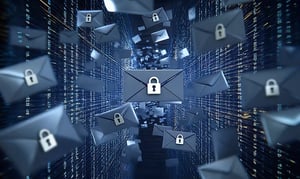
Standard mail providers encrypt the channel in transit with TLS, but on delivery the content becomes readable again in the recipient's mailbox, where it can be copied and forwarded onto servers you don't govern. CyberGrant moves the protection onto the data. With EmailGrant, the secure messaging module of FileGrant, every message is encrypted inside the platform, tracked and revocable, and attachments inherit the same policies as your corporate files. It's the file-centric approach to data protection applied to email: protection follows the message beyond the mailbox, for the entire life cycle of the data.
Every message stays under your control, even after you send it
When an email leaves your company, it usually leaves your line of sight too. You don't know if it was opened, from which device, or whether it was forwarded. With standard email, once you hit send, the message is no longer yours.
EmailGrant, the secure messaging module of FileGrant, makes every message trackable in real time: who opened it, when, from which IP. If you wrote to the wrong recipient or want to pull a document back, you revoke access to an already-sent email, even while the recipient is reading it. Control stays with you after you send, not only before.
Your policies travel with the file, inside and outside the mailbox
An attachment sent by email is a file that leaves the perimeter with no rules attached. Once downloaded, it can be copied, forwarded, and edited, and your corporate policies stop at the mailbox door.
With EmailGrant, attachments inherit the same protections as files managed in FileGrant: classification, permissions, screenshot blocking, revocation, and an audit trail. The download happens in encrypted Lock&Go format, with quantum-safe CRYSTALS-Kyber encryption (NIST FIPS 203 standard). If an internal policy forbids sharing an unclassified document, the email doesn't go out. The control is systemic and doesn't depend on any one person's attention.


A safety net for the mistakes that happen anyway
The human element shows up in 62% of data breaches (Verizon DBIR 2026), and sending to the wrong recipient is among the leading errors behind a breach. No attack required: one person in the wrong line, a file attached by mistake, a document shared for too long.
EmailGrant shrinks the surface for these mistakes. You set an expiration on the message, and on the set date the email closes even if it's already open. You revoke access with one click. You authenticate the recipient by account or OTP. The wrong move is still possible, but it no longer causes lasting damage.
Encryption that holds even if the recipient's mailbox is compromised
Traditional mail providers don't encrypt end-to-end. If the recipient's mailbox is breached, your data is breached with it. In Italy, phishing is the dominant threat category at 70.7%, ahead of malware and business email compromise (Clusit Report 2026). A compromised mailbox is not a hypothetical.
For the most sensitive communications, EmailGrant protects the message with an extra password-based layer: the content is encrypted on the front end too, and no one, not even the system administrator, can read it without the key. Attachments leave in Lock&Go format with quantum-safe CRYSTALS-Kyber encryption (NIST FIPS 203 standard), built to hold against harvest now, decrypt later. With on-premise deployment and zero-knowledge keys, sensitive mail stays under the company's sovereignty.

READ THE ARTICLE
 See what happens to an email after you hit send
EmailGrant extends to your inbox the same policies that protect your corporate files: tracking, revocation, expiration, and persistent encryption on the message and the attachment.
FAQ
It's an approach that moves protection from the network perimeter to the individual message and its attachments. Instead of only filtering mail, it encrypts the content, tracks access to it, and keeps expiration and revocation active even after you hit send. Protection follows the data beyond the recipient's mailbox, for its entire life cycle.