
Skip to content

CyberGrant protects every aspect of your digital security

Discover the modular solutions designed to protect your company from external and internal threats, as well as new challenges like AI.

Data loss prevention icon

Digital asset protection

Automatic classification

Transparent encryption

Cloud encryption

Anti-phishing

Access management icon

Remote access

Access rules

Credentials

Stolen Device

Web access

Email security icon

Post-send control

Protected Attachments

Human error

Advanced encryption

Endpoint protection icon

Beyond Antivirus

External Threats

Data Exfiltration

Remote Work

Zero trust

Monitoring icon

Device control

Shared files

Audit Trail

Credential Access

Email Channel

Anomaly detection

Credentials protection icon

Company vault

Controlled sharing

Zero-trust encryption

Logging and generation

Secure file sharing icon

Third-party users

RBAC

Anti-AI scraping

VDR

Compliance icon

GDPR and encryption

NIS2

DORA

AI act

Audit

Artificial intelligence icon

AI control

Automated classification

AI blocking

Private AI

Security assessment icon

Attack Surface Mapping

Penetration testing

Ransomware

Human Factor

After the Test

Tailored cybersecurity for every business.
Scalable solutions compatible with legacy systems, designed for both SMEs and large enterprises requiring full control over data, access, and sharing.


IT
Consulting
Travel
Advertising

Construction
Real Estate

Oil & Gas
Electricity
Telco

E-commerce
Transportation
Shipping
Retail chains

Design
Automotive
Industrial

Central agencies
Local agencies
Supranational orgs

Discover security features to protect your data, files, and endpoints

PRODUCTS


FileGrant iconFileGrant
RemoteGrant iconRemoteGrant

Securely store, share, and manage your files with an advanced, easy-to-use, and highly customizable platform.

RemoteGrant protects your business from attacks and data loss by enabling employees to securely access workstations and files from anywhere.

EXTENSIONS


CyberGrant Connector iconConnector
AIGrant iconAIGrant
EmailGrant iconEmailGrant
SecretGrant icon SecretGrant

Encrypts every file on SharePoint and OneDrive, in any format, leaving your libraries, permissions, and daily workflows untouched.

Private on-premise AI: answers questions about company documents in plain language, applies FileGrant permissions and keeps data away from public AI.

Encrypt every email and keep control of attachments, even after sending.

Control every credential like a file. Share, track, and revoke access instantly.

Explore Connector Explore AIGrant Explore EmailGrant Explore SecretGrant
Form-linee-e-cerchi-CYBERGrant
DOWNLOAD THE WHITE PAPER

Hotel guest data protection: GDPR, PCI DSS, and NIS2

A 5-step operational framework for hotels and hospitality groups

Every day, the front desk handles some of the most sensitive data any business collects: passports, payment cards, and personal preferences that can reveal a guest's health or religion. Together, these records often build a fuller profile than a bank holds, yet they rarely get the same level of protection.

The real question isn't which policies a hotel has adopted. It's where guest data ends up after check-in, and what protects it once it gets there.

The cases analyzed in the white paper all point to the same pattern:

  • In 2023, MGM Resorts estimated a roughly $100 million impact after a social engineering attack that started with a call to its IT help desk (source: MGM Form 8-K)
  • In summer 2025, more than 100,000 scanned ID documents stolen from 12 Italian hotels went up for sale on the dark web (source: CERT-AGID, Italy's government CERT)
  • PMS platforms, channel managers, OTAs, and outside vendors multiply the entry points to guest data
  • High staff turnover and shared workstations leave credentials active and no record of who did what

A stolen passport scan never expires. It fuels identity theft and fraudulent bank accounts, and it gets resold again and again, long after the original breach.

This isn't a future scenario. It's happening now, at properties run just like yours.

Download the white paper and learn how to govern guest data with protection that follows it wherever it goes.
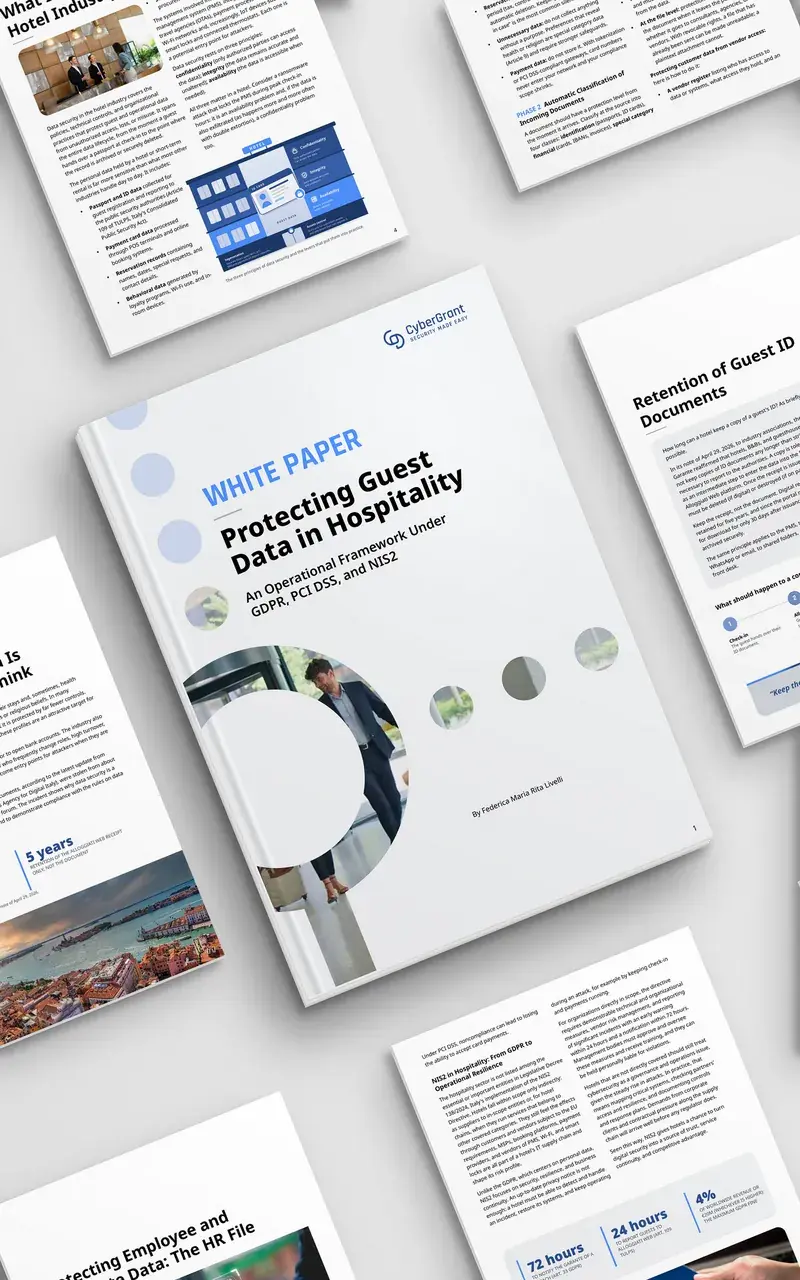
CG_WP_09-Hospitality-mockup-800x1280-eng

WHITE PAPER – HOSPITALITY DATA PROTECTION

What's inside the hotel guest data protection white paper


  • What data a hotel actually holds: ID documents, payment cards, reservations, behavioral data, and HR records

  • How the regulations stack up: GDPR, PCI DSS, mandatory guest registration with the police in Italy, and NIS2

  • How long a hotel may keep a copy of a guest's ID, according to Italy's Data Protection Authority

  • Where the industry is most exposed: PMS and channel managers, staff turnover, shared workstations, and outside vendors

  • What three recent breaches reveal: MGM Resorts, Caesars Entertainment, and 12 Italian hotels

  • A 5-step operational framework, from data inventory to breach notification within 72 hours

Free PDF. No spam. GDPR-compliant. Unsubscribe anytime.


WHO THIS CYBERGRANT WHITE PAPER IS FOR

Who is responsible for guest data in a hotel?

DPO CISOs and IT leaders

They run the PMS, networks, access controls, and technology vendors. The white paper shows where risk concentrates and how to apply encryption, role-based access, and audit trails.

 
hotel-director Hotel general managers and owners

They answer for service continuity and the property's reputation. The white paper explains why a breach shuts down reservations, payments, and check-in, not just IT systems.

 
compliance-team DPOs and compliance teams

They answer for compliance with GDPR, PCI DSS, and NIS2. The white paper clarifies the rules on ID retention, breach notification, and vendor management.

 
KEY TOPICS IN THE WHITE PAPER

From check-in to breach notification: the risks to hotel guest data

Free PDF. No spam. GDPR-compliant. Unsubscribe anytime.


Frequently asked questions about hotel guest data protection

What guest data does a hotel need to protect?

ID documents, payment card data, reservations, and preferences that can reveal a guest's health or religion, plus employee records. Together they form a complete profile that, once stolen, fuels identity theft and gets resold many times over.

Which regulations govern hotel guest data?

PCI DSS applies wherever a hotel accepts payment cards. In the US, every state has its own data breach notification law. In Europe, GDPR covers all personal data and national rules such as Italy's police guest registration apply locally. NIS2 does not apply to hotels directly, but it can reach them if they run activities in covered sectors or supply services to NIS2 entities.

How long can a hotel keep a copy of a guest's ID?

In Italy, only as long as it takes to send the data to the police through Alloggiati Web. Once the receipt is issued, the copy must be deleted or destroyed, and only the receipt is kept, for 5 years. Italy's Data Protection Authority confirmed this on April 29, 2026.

How quickly must a hotel report a data breach?

It depends on the jurisdiction. Under GDPR, within 72 hours of becoming aware of it, to the data protection authority (Article 33). In the US, 20 states set a fixed deadline for notifying affected individuals, as short as 30 days in California, Colorado, Florida, New York, and Washington. The others require notice without unreasonable delay.

What are the most common data security weak points in hotels?

PMS platforms and channel managers tied to dozens of integrations, seasonal staff on shared accounts, shared front-desk workstations, and vendors with remote access. Any access without a named user or an expiry date stays open long after anyone uses it.

How can hotels protect guest data after it leaves the property?

By encrypting each file, so protection stays in place wherever the document is copied or sent. Add role- and shift-based access with instant revocation, plus an audit trail of every time the file is opened.